

Q3 2026 MARKET RECAP AND OUTLOOK
Stock markets delivered modest gains during the third quarter. After trading largely sideways through July, equities rallied in early August, supported by strong corporate earnings and optimism surrounding a potential U.S.-Iran agreement that could reopen the Strait of Hormuz. However, the rally quickly lost momentum, as enthusiasm surrounding artificial intelligence cooled and rising interest rates weighed on investor sentiment.
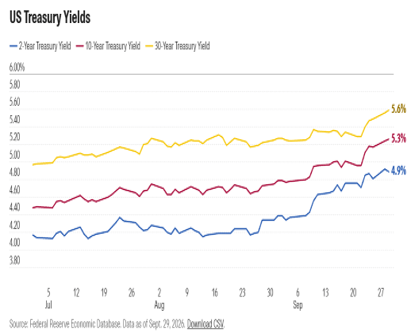
While corporate earnings remained resilient and economic growth continued, the bond market ultimately became the quarter's focal point. Concerns over expanding fiscal deficits, higher interest rates, and persistent inflation, exacerbated by the ongoing conflict in Iran, pushed government bond yields to multi-decade highs. The U.S. 10-year Treasury yield, a key benchmark for consumer and business borrowing costs, rose more than 19% during the quarter (see chart to the right).
U.S. equity markets produced mixed results. The S&P 500 Index gained 2.3%, while the NASDAQ Composite Index advanced 2.6%. In contrast, the Dow Jones Industrial Average declined 2.3%. Market leadership, which had broadened somewhat earlier in the year, narrowed once again, with only a handful of stocks and sectors driving returns. Small and mid-cap equities lagged their large-cap counterparts, as higher interest rates and refinancing pressures weighed more heavily on smaller companies. The Russell 2000 Index fell 7.2% during the quarter. Sector performance was similarly concentrated. Only four of the eleven S&P 500 sectors finished in positive territory. Energy (+17.2%) and information technology (+7.2%) led the market, while more interest-rate-sensitive sectors such as utilities (-12.4%) and industrials (-9.7%) were heavy decliners.
Canada’s S&P/TSX Composite Index advanced 1.6% in Q3, but the materials sector was the primary driver of performance, benefiting from strength in metals and mining companies. According to Morningstar, “The Morningstar Canada Index gained 1.9% in the third quarter, with materials contributing 2.1 percentage points. Put differently, the index would have declined without the sector’s contribution.” The technology (+17.9%), materials (+12.9%), and energy (+3.3%) sectors posted gains during the quarter, while the remaining eight sectors finished lower. Communication services (-9.3%), utilities (-7.2%), and real estate (-7.2%) were the weakest performers.
International markets delivered mixed results. European equities lagged, with the MSCI Europe ex UK Index declining 1.3% as rising bond yields and renewed energy-driven inflation concerns weighed on sentiment. Japanese equities gained 2.6% and Chinese equities advanced 3.6%, as investors grew increasingly confident in the strength of both economies and their expanding roles within global technology and AI supply chains. South Korea was among the weakest performing markets, declining 20.9% as semiconductor-related stocks retrenched after strong gains earlier in the year. Despite the sharp quarterly pullback, Korean equities remained up more than 86% year-to-date.
As noted earlier, bond markets generated much of the quarter's volatility. Both the Federal Reserve and European Central Bank raised policy rates by 25 basis points in response to persistent inflation pressures. More significantly, U.S. Treasury yields moved above 5%, a level often viewed as psychologically important by investors. The prospect of sustained borrowing costs at these levels has prompted renewed questions about the outlook for economic growth and corporate profitability. Against this backdrop, fixed income markets struggled, with the FTSE Canada Universe Bond Index declining 3.0% and the Morningstar Global Core Bond Index falling 2.5%.
After a challenging second quarter, gold regained some of its shine, rising 3.7% during the period. Bitcoin also rebounded strongly, gaining more than 40% as increased spot market activity and growing institutional demand helped reverse much of its year-to-date decline.
Looking ahead, we believe headwinds continue to build. Elevated interest rates, persistent inflation, and economic growth that remains heavily dependent on AI-related infrastructure spending reinforce the importance of prudent risk management and reliable portfolio cash flow. That said, as noted in our previous commentary, if corporate earnings continue to deliver, equity markets may still have room to advance despite an increasingly challenging backdrop.
What Could the U.S. Midterm Elections Mean for Investors?
As the U.S. midterm elections approach, investors (and advisors) are understandably focused on the potential implications for markets and the economy. While it’s natural that politics have moved to the centre of conversations and election news is generating outsized media attention, history suggests that political outcomes are rarely the driver of long-term investment returns. Economic growth, corporate earnings, inflation, and interest rates have proven far more influential than the party composition of Congress. In fact, markets have historically delivered positive long-term returns under both Republican and Democratic administrations, as well as under both unified and divided governments.
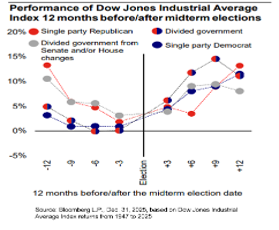
With that said, elections can influence market sentiment and investor behaviour in the shorter term. Although 2026 has been a relatively calm year for financial markets, midterm election years have historically been associated with periods of increased volatility, as investors assess the potential implications of changing political priorities and policy agendas. Interestingly though, markets have often performed well following midterm elections, as uncertainty subsides and investors gain greater confidence in the direction of government policy. As seen on the right, historical data shows that in the 12 months following midterm elections, regardless of the specific outcome, equities have typically performed well.
This election cycle, however, feels particularly significant because it comes at a time when, despite solid pockets of economic growth and substantial AI investment, many households remain frustrated by increasing housing costs, surging energy prices, growing healthcare expenses, and higher interest rates.
In recent months, markets have been grappling with the prospect of interest rates remaining higher for longer, as inflation pressures persist and energy prices remain elevated. With U.S. Treasury yields moving above 5%, some investors worry that higher borrowing costs could present a challenge for equity markets. The key risk may not necessarily be recession, but rather the impact that higher bond yields can have on stock market valuations, particularly among growth-oriented and highly leveraged companies. Sectors with elevated valuations and greater sensitivity to interest rates may face increased pressure if earnings growth fails to keep pace with expectations.
At the same time, higher bond yields are not inherently negative for equities. If yields remain elevated because economic growth is strong and corporate profits continue to expand, stocks can still generate attractive returns. However, if yields are rising due to renewed inflation pressures or growing concerns over government deficits and debt sustainability, market volatility could increase. This is one of the reasons why bond markets may ultimately prove more important to investors than election results themselves. A shift in congressional control could also influence future fiscal spending, taxation and regulatory policy. A divided government, which many view as a plausible outcome, may make it more difficult to pass major legislation and could result in a greater degree of policy stability. Markets have often viewed legislative gridlock favourably because it reduces the likelihood of significant and unexpected policy changes.
A quick note on the evolving Canada-U.S. trade relationship and how the midterm election may impact this. Certainly, a more stable political environment and renewed focus on economic growth could support an easing of tensions. That said, trade policy remains largely driven by the executive branch (i.e. the President) and it’s important to note that protectionism had been gradually increasing even before Donad Trump took office. Given that, we don’t expect the end of trade hostilities simply because of a change in congress. If Democrats win both the House and the Senate, there will likely be a push to rein in the current U.S. trade policy – but it is more likely that inflation, elevated bond yields, and continued public opposition to both the Iran war and the trade conflict with Canada could pressure the White House to make a deal. Even so, we don’t expect a return to the trade deals of old.
While election headlines are likely to dominate the news flow over the coming weeks, successful investing has rarely depended on correctly predicting political outcomes. Instead, we remain focused on the factors that have historically mattered most to long-term market performance: the outlook for corporate earnings, the path of inflation, and whether bond yields stabilize at more sustainable levels. As always, we believe investors are best served by maintaining a disciplined, long-term approach, staying diversified, and focusing on the fundamental drivers of portfolio returns. We will continue to monitor developments closely and make portfolio adjustments where appropriate, to manage risk and capitalize on opportunities as they arise.

Ryan Cramp, CIM, CFP®
Portfolio Manager
Private Client Group, Raymond James Ltd.

Michael Higgins, BCom, CIM®, FCSI
Associate Portfolio Manager
Private Client Group, Raymond James Ltd.
This Quarterly Market Commentary has been prepared by Ryan Cramp and Michael Higgins and expresses the opinions of the authors and not necessarily those of Raymond James Ltd. (RJL). Statistics and factual data and other information are from sources RJL believes to be reliable but their accuracy cannot be guaranteed. The client account performance may vary from the model portfolio due to several factors, including the timing of contributions and dates invested in the model. The performance reported is that of the account that represents the model, not a composite. Performance calculation for the models may be different than the index used as a reference point. It is for information purposes only and is not to be construed as an offer or solicitation for the sale or purchase of securities. This Quarterly Market Commentary is intended for distribution only in those jurisdictions where RJL and the author are registered. Securities-related products and services are offered through Raymond James Ltd., member-Canadian Investor Protection Fund.
Raymond James Ltd. has managed or co-managed a public offering of securities within the last 12 months with respect to CES Energy Solutions, Boyd Group Services Inc. and Exchange Income Corp.
Raymond James Ltd. has also provided investment banking services within the last 12 months with respect to CES Energy Solutions, Boyd Group Services Inc. and Exchange Income Corp.