

Q2 2026 MARKET RECAP AND OUTLOOK
After an inauspicious end to the first quarter, stock markets staged an impressive rally as geopolitical tensions eased, at least temporarily, during the second quarter. Oil, which had peaked above $115 per barrel in early April, fell back to a still-elevated but much more palatable range near $70 by quarter-end, helping to alleviate worst-case inflation fears. Combined with a surge in corporate profits, particularly among technology companies, virtually all major equity markets posted strong gains through late May.
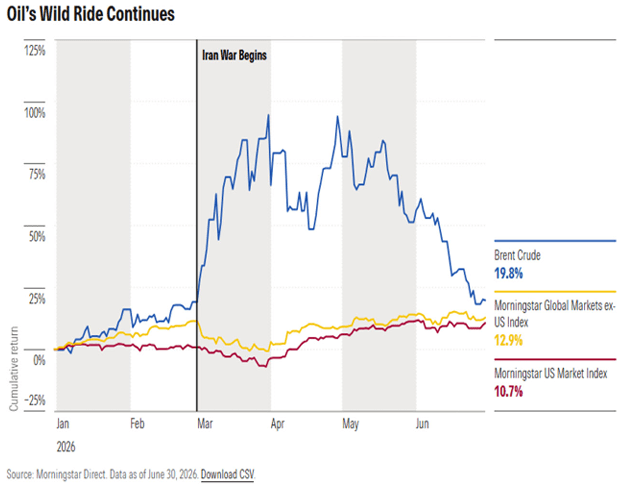
June, however, saw markets move largely sideways as investors weighed growing expectations for U.S. interest rate hikes, re-escalating geopolitical tensions, and whether earnings growth can continue to justify the market's lofty valuations.
U.S. markets posted their best quarter since 2020, with the S&P 500 Index gaining 15.2%, the NASDAQ Composite Index advancing 21.6%, and the Dow Jones Industrial Average rising 13.4%. These gains pushed all three major indices firmly into positive territory for the year. As noted above, corporate earnings among AI related and technology companies were particularly strong, but even excluding the technology sector, U.S. earnings growth was nearly double its historical pace.
Not surprisingly, nine of the eleven S&P 500 sectors finished the quarter in positive territory. Information technology led the way with a gain of 31.8%, while energy (13.5%) and utilities (-0.5%) were the only sectors to decline, largely reflecting falling oil prices. Growth stocks once again outperformed value stocks, although market leadership broadened meaningfully as small and mid-cap companies outperformed their large-cap counterparts.
Canadian markets, which had significantly outperformed during the first quarter, continued to advance despite the economy entering a technical recession. The S&P/TSX Composite Index gained 7.0% during the quarter. Declines in resource prices, with oil and gold falling more than 30% and 10%, respectively, were not enough to offset strong performance from financial stocks.
As expected, the energy (-5.0%) and materials (-11.5%) sectors declined during the quarter, joined by communication services (-10.0%). Financials (+25.6%) and health care (+14.0%) led the advancing sectors. The Canadian dollar continued to drift lower against its U.S. counterpart, as lingering uncertainty surrounding CUSMA negotiations and diverging central bank policies weighed on the loonie.
The second-quarter rebound in equities extended across international markets as well, pushing European markets into positive territory for the year. European equities gained 14.4% during the quarter and are now up 11.8% year-to-date. Technology-heavy South Korea continued its remarkable advance, with the MSCI Korea Index up more than 135% since the beginning of the year. China, however, continued to struggle. Chinese equities declined 6.8% during the quarter and are now down 14.8% year-to-date as economic growth slowed to its weakest pace in three and a half years.
Bond markets experienced a volatile quarter. Yields initially moved higher, alongside rising inflation and growing expectations for Federal Reserve rate hikes, but later retreated as oil prices declined and tensions in the Middle East moderated. Despite this volatility, both the FTSE Canada Universe Bond Index (+2.0%) and the Morningstar Global Core Bond Index (+2.6%) delivered solid positive returns.
Gold continued its downward trend, falling 12.6% during the quarter. This weakness surprised many investors who had expected geopolitical uncertainty and higher inflation expectations to provide support for the precious metal. Similarly, Bitcoin, often described as "digital gold," declined approximately 13% during the quarter and has now fallen more than 50% from its peak reached last October.
Investors were largely willing to look past many of the headwinds facing markets during the second quarter. However, with U.S. midterm elections, ongoing Middle East conflict, shifting interest rate expectations, contentious trade negotiations, and ambitious earnings growth forecasts all carrying the potential to disrupt markets in the months ahead, we remain focused on managing risk while seeking long-term opportunities for our clients.
OUTLOOK – Earnings matter
Investors can be forgiven for feeling a little confused. Clearly, all is not right in the world. Energy prices remain elevated, affordability is strained, inflation and bond yields have been rising, protectionism is growing, geopolitical tensions remain high, and consumer sentiment has fallen to some of its lowest levels in nearly 50 years. Yet despite these headwinds, stock markets continue to push higher. To be sure, markets still have their down days, as mentioned earlier; they have largely traded sideways since early June, but over the past year, investors have consistently looked beyond the latest concern and continued to push markets higher. How is that possible?
The answer is earnings.
Despite these challenges, corporate earnings growth has been far stronger than anticipated, with S&P 500 earnings growing at more than double the rate of consensus forecasts projected earlier this year. As Kelly Bogdanova, Vice President and Portfolio Analyst with RBC's Portfolio Advisory Group, recently noted: “Outside of post-recession rebounds, earnings growth rarely exceeds expectations by such a large magnitude. In other words, it's an eye-popping difference.”
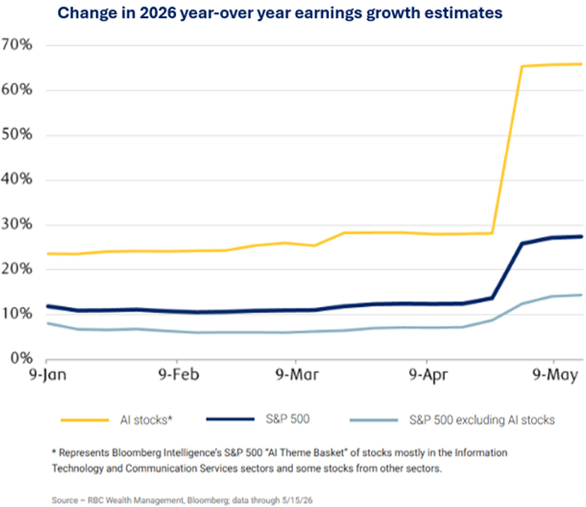
While the AI investment boom deserves much of the credit for this growth, it is worth noting that even when those companies are excluded (see chart on the right), S&P 500 earnings growth is still expected to reach 14.4%, well above historical averages. Current consensus estimates call for double digit earnings growth in each of the next six quarters.
Given the concerns outlined above, the key question becomes: Can earnings growth live up to these lofty expectations, and can markets continue moving higher? While there are certainly risks that could derail these forecasts, and we remain mindful of them, here are several reasons to believe the market's advance may have further room to run:
- Earnings growth broadening – As noted above, AI-related and mega-cap companies have done much of the heavy-lifting when it comes to earnings growth. However, the story is becoming increasingly broad-based. Seven of the eleven S&P 500 sectors are expected to deliver double-digit earnings growth, suggesting that strength is spreading across the market. According to research from Fidelity Investments: “Median corporate earnings remain below the previous peak reached in 2018, suggesting many companies have been working through a longer recovery period following the pandemic and its economic disruptions. Historically, earnings cycles that take longer to recover have often lasted longer once new highs are reached. If that pattern holds, this bull market could potentially endure.”
- Valuations supported by earnings – Stocks are by no means cheap, but valuations remain reasonable when viewed in the context of expected earnings growth. The market-cap S&P 500 Index currently trades at approximately 20 times forward earnings, while the equal weighted S&P 500 Index trades closer to 18 times. These valuations are somewhat above long-term averages but are not particularly extreme. For perspective, these valuation multiples exceeded 120 times earnings during the height of the dot-com bubble. Companies will ultimately need to deliver on current earnings expectations, but for now, market valuations do not appear disconnected from the earnings outlook.
- Consumers & investors remain cautious – As Denise Chisholm, Director of Quantitative Market Strategy at Fidelity, recently wrote, “The enemy of stock investing is euphoria.” It is difficult to argue that euphoria is widespread today. Consumers, challenged by inflation and an unpredictable trade environment, have continued to spend, largely supported by a resilient labour market, even as sentiment surveys remain near historic lows. Investors, meanwhile, continue to maintain a healthy degree of skepticism, despite several years of strong market returns. While there are pockets of exuberance, there is little evidence of the broad-based optimism and complacency that have often characterized market peaks.
For many investors, continued market gains in the face of these challenges can feel unsettling. We know that markets do not rise indefinitely, and we remain vigilant regarding the risks that could impact future growth. That said, we remain long-term believers in the power of markets and continue to have confidence in the investment plans we have established with our clients. While short-term uncertainty is inevitable, successful investing is built on maintaining discipline and focusing on long-term objectives.
As always, if you have any questions about the markets or your portfolio, please do not hesitate to reach out. We would be happy to discuss your individual situation.

Ryan Cramp, CIM, CFP®
Portfolio Manager
Private Client Group, Raymond James Ltd.

Michael Higgins, BCom, CIM®, FCSI
Associate Portfolio Manager
Private Client Group, Raymond James Ltd.
This Quarterly Market Commentary has been prepared by Ryan Cramp and Michael Higgins and expresses the opinions of the authors and not necessarily those of Raymond James Ltd. (RJL). Statistics and factual data and other information are from sources RJL believes to be reliable but their accuracy cannot be guaranteed. The client account performance may vary from the model portfolio due to several factors, including the timing of contributions and dates invested in the model. The performance reported is that of the account that represents the model, not a composite. Performance calculation for the models may be different than the index used as a reference point. It is for information purposes only and is not to be construed as an offer or solicitation for the sale or purchase of securities. This Quarterly Market Commentary is intended for distribution only in those jurisdictions where RJL and the author are registered. Securities-related products and services are offered through Raymond James Ltd., member-Canadian Investor Protection Fund.